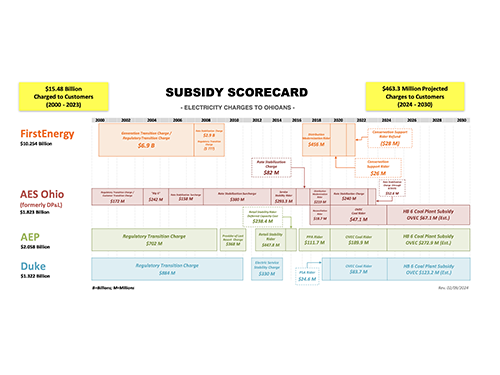

Electric rates for FirstEnergy customers could be more expensive than is reasonable if the utility is allowed to implement a new proposal to charge customers from June 2014 to May 2016. Because of this, the FirstEnergy rate plan should be rejected by the Public Utilities Commission of Ohio (PUCO).
The Office of the Ohio Consumers’ Counsel (OCC) filed testimony in May to show that the proposal from FirstEnergy could result in higher rates for customers than what is reasonable by including unnecessary costs, by acquiring power to serve customers for a three-year time period, instead of a lesser term that would be more beneficial, and by weakening a consumer protection included in Ohio law. Hearings were held in June.
As part of its request, FirstEnergy is seeking to collect from customers an additional $405 million over two years for distribution costs. The utility does not specify what, if any, improvements to its system or reliability would be made with the additional money. Additionally, FirstEnergy is required to revise its reliability standards by 2014, and should fulfill this commitment before customers are charged any more for its distribution operations, the OCC said.
In 2009, there was a case providing a full review of FirstEnergy’s distribution costs. In that review, the PUCO only allowed the utility to collect about 40 percent of its request, or about $137 million annually.
FirstEnergy also is seeking to exclude interest on deferred charges from its calculation of profits. This could weaken a protection in Ohio law that requires a utility to return money to customers if it reports significantly excessive profits. The PUCO has previously maintained that deferrals should not be excluded when testing for significantly excessive profits. The OCC has advocated that FirstEnergy customers should have the protection of this test as intended in Ohio law, by including deferrals and the interest-related charges in the profits review.
The OCC also advocated that a main tenet of FirstEnergy’s new request be rejected. The utility wants to use an auction process that would include acquiring generation for a three-year period. But in doing so, FirstEnergy’s rates would likely be higher because of a number of uncertainties that could affect the three-year auction, including power plant closures, among others. To help avoid the risk of these uncertainties and higher prices that could result, an auction should supply generation for no more than two years, the OCC said.
After the remainder of the case is completed, the PUCO commissioners will make a decision.
By Anthony Rodriguez

Ohioans have already been taking advantage of 10-year lows in natural gas prices for their heating needs. With the vast reserves available, there also is progress being made to make natural gas vehicles a larger part of the vehicle footprint in Ohio – along with their lower fuel prices.
Gov. John Kasich and governors from 12 other states have agreed to a coordinated effort to encourage auto manufacturers to build more compressed natural gas vehicles in the United States.
The governors are seeking to increase the number of natural gas vehicles in government and large company fleets, expanding the number of vehicles where natural gas fuel is most commonly used. Natural gas fuel is most often used in government vehicles, transit buses, garbage trucks, taxis and school buses. The 13 states plan to work with local agencies, municipalities, and companies to gauge how many natural gas vehicles could be purchased.
If more natural gas vehicles are built for government and private companies, it could lead to more fueling stations and availability of passenger vehicles for consumers to purchase.
But the question of whether natural gas vehicles or fueling stations should be built first to spur development has the market in flux. A recent study funded by America’s Natural Gas Alliance said the U.S. needs more public fueling stations to make natural gas vehicles feasible. Building at least 10 percent of the number of gasoline stations in the U.S. would help make natural gas vehicles competitive, the study said.
Currently, there are 120,000 natural gas vehicles on U.S. roadways. There are about 1,000 natural gas stations compared to almost 120,000 gasoline stations in the United States. And 59 percent of the natural gas stations are private. In Ohio, there are 19 natural gas stations operating, but only six are available for use by the public. There are plans in the works for 13 more filling stations.
Home-filling stations do exist and could be installed with existing natural gas lines. And certain existing vehicles also could be converted to use natural gas. Both endeavors are quite expensive.
If the governors’ agreement leads to a significant build out of natural gas vehicles, their goal is to break the ‘chicken and the egg’ argument and lead individual consumers to have more, and possibly cheaper, driving options available to them.
By Anthony Rodriguez
Water and sewer rates are scheduled to increase for Aqua Ohio Water customers after the Public Utilities Commission of Ohio (PUCO) approved a settlement of its latest rate case in June.
But the rate increase will be about $2 million lower than what Ohio American Water (OAW) originally proposed prior to signing another settlement this past winter approving the company’s acquisition by Aqua America Inc. That settlement, which paved the way for OAW’s acquisition by Aqua America, resulted from negotiations among the Office of the Ohio Consumers’ Counsel (OCC), the water company, and the PUCO Staff.
OCC agreed to not oppose the subsequent rate case agreement, which allowed Aqua Ohio Water to collect an additional $4.2 million from all of its customers.
An average customer’s bill will be impacted as follows:
Customer bill impacts based on 7 Ccf monthly usage |
||||
Service Territory |
Proposed |
Current |
New |
Percentage increase from current prices |
Marion (w/softening) |
$65.11 |
$53.65 |
$59.58 |
11.1 |
Ashtabula, Tiffin, Lawrence County, Lake White |
$62.10 |
$51.19 |
$56.58 |
10.5 |
Blacklick, Timberbrook, Portage |
$62.10 |
$49.70 |
$56.58 |
13.8 |
Lake Darby, Worthington Hills |
$67.71 |
$53.72 |
$62.18 |
15.8 |
Huber Ridge |
$72.03 |
$60.19 |
$66.50 |
10.5 |
Wastewater |
$69.03 |
$61.85 |
$64.39 |
4.1 |
Water quality issues in the Blacklick service territory also will be investigated as a result of the settlement.
By Anthony Rodriguez
American Electric Power’s (AEP) residential customers are being asked by the utility to pay the largest increase among major customer classes in its latest proposal to increase rates.
The proposal would raise rates as much as 6 percent through May 2013, with additional increases during the next two years.
The Office of the Ohio Consumers’ Counsel (OCC) is concerned about the burden this level of increase would have on residential customers. Additionally, several charges proposed by AEP are overly expensive and should be denied or modified by the Public Utilities Commission of Ohio (PUCO).
One charge, called a rate stability rider, would provide AEP an additional revenue stream estimated at $284 million to account for money the utility predicts it would lose from customers who shop for another electric generation service provider. This charge would be greatest to residential customers even though they are shopping the least – only 8 percent of residential customers have chosen an alternative supplier. The OCC believes this charge is not allowed by law and should be denied by the PUCO.
The OCC also is concerned about a charge that could be affected by other pending cases. A cap was placed on the amount of costs AEP could collect from customers in its last rate plan. The utility was allowed to delay collection of fuel-related costs that were above the cap. AEP wants to delay collection of the accumulated deferred fuel expenses for a year, with a high interest rate, which would increase interest-related costs to be paid by customers. This charge should, at a minimum, be collected subject to refund so the money could be returned if the pending cases are ruled in customers’ favor, the OCC said.
A third charge the OCC believes should be denied has a more than $365 million price tag for distribution investments.
At the time of publication, the OCC and several other parties in the AEP rate case were collecting evidence to present to the PUCO for its consideration. A decision was not expected to come from the PUCO until at least July.
By Anthony Rodriguez
According to estimates by Dayton Power and Light (DP&L), its current proposal to price generation rates using a market-based formula could lead to a 3 to 5 percent decrease in customers’ bills in January 2013 if approved by the Public Utilities Commission of Ohio (PUCO).
The plan would move generation costs, which account for more than half of a customer’s monthly bill, to a market-based pricing formula over a six-year period. The move to fully competitive market rates would be gradual and not completed until 2018.
At the time of publication, the Office of the Ohio Consumers’ Counsel (OCC) was still analyzing DP&L’s proposal, but after an initial review, the residential utility consumer advocate voiced concerns with elements of the plan that suggest it could harm residential customers.
Generally, the OCC was concerned about the legality of including a new “stability” charge that could add hundreds of millions of dollars to customers’ bills over the six-year course of the proposal, and also about how proceeds from coal trading would be shared with customers.
Since a market rate option became available for utilities to price electricity, the PUCO has never approved one. Both FirstEnergy and Duke proposed market rate offers which were eventually rejected. The staff of the PUCO has recommended that DP&L consider submitting an electric security plan rather than proceed with a market rate option.
By Anthony Rodriguez

Unauthorized telephone charges were a big news issue in the spring after the Federal Trade Commission (FTC) asked a federal court to require a third-party billing company to return more than $52 million in charges unlawfully added to consumers’ phone bills.
The FTC claimed that Billing Services Group, a company based in San Antonio, added about $70 million in bogus charges to phone bills over a five-year period. The FTC alleged that Billing Services Group was guilty of a practice known as “cramming.” A decision in this case is still pending.
Cramming can result in customers having unauthorized charges on their local phone bill. While the amounts billed are usually small, over a period of time they can add up. Often, customers are never even aware they have been paying for services they never requested or for phone calls they never made.
The Office of the Ohio Consumers’ Counsel (OCC) educates consumers about cramming and other nefarious practices by companies seeking to make a dishonest buck from the unsuspecting. The residential consumer advocate has a list of often-reported scams and ways to avoid falling victim to them on its website, www.pickocc.org. The fact sheet, How to Avoid Cramming, includes examples of cramming schemes and ways for consumers to avoid them. The publication also explains what you should do if you feel you’ve been crammed.
The best way to stay on top of unwanted costs is to thoroughly read the fine print on any contest forms you complete, and review your phone bill each month to make sure you’ve authorized all the charges on the bill. Also, talk to your children and anyone else using your telephone to alert them about the costs of calling those special 900 numbers that offer information and entertainment. Contact your local phone company if you see any charges on your bill that you do not think should be there and ask that they be removed. Also, consider putting a block on your account to prevent unauthorized charges and keep a log of all the services you do authorize.
Many cramming incidents occur because third-party billing agents submit inaccurate charges to the local telephone company, which, in turn, bills consumers for those costs. In addition to being costly, the time spent having to unravel mystery charges can be emotionally taxing as well.
Laws are in place to protect consumers from costly cramming schemes and other scams. But the best way to avoid falling victim to scams is to be alert and keep thorough records of all of your communications activities.
By Marty BerkowitzEach year at this time, hot temperatures can contribute to high electric bills as Ohioans crank up their air conditioners to deal with excessive heat and humidity. For those who struggle to pay their utility bills, summer can be an especially challenging time.
This summer, as in previous years, assistance is available to income-eligible households through the federally-funded Low-Income Home Energy Assistance Program (LIHEAP) - Summer Crisis Program.
The Office of the Ohio Consumers' Counsel (OCC) offers information about this and other payment assistance programs at its website, www.pickocc.org.
The Summer Crisis Program, administered by the Ohio Department of Development (ODOD), has undergone several significant changes this year that should benefit income-eligible customers. Benefits were made available June 1 this year, a month earlier than previous years. The program continues through Aug. 31, 2012.
Households with a gross annual income at or below 200 percent of the federal poverty guidelines ($46,100 for a family of four) are eligible for a one-time payment of up to $250 toward their electric bill or, depending on where in Ohio they live, assistance with cooling equipment such as an air conditioner or fan, if available.
Cooling assistance through the Summer Crisis Program will be available to income-eligible households which include a member who is at least 60 years of age or older; or who has a doctor-documented health condition. Applicants who have received a disconnection notice and meet the income guidelines also would qualify for assistance under the program.
To apply for assistance, consumers need to contact their local community action agency, which will determine individual benefits. Consumers also should work with job and family services and other community organizations for help.
Information about the 2012 Summer Crisis Program and other assistance programs is available at energyhelp.ohio.gov, or by contacting the ODOD consumer hotline at 1-800-282-0880 or TDD 1-800-686-1557. Consumers can identify their local community action agency by visiting the ODOD website at http://www.odod.state.oh.us/cdd/ocs/locate.htm.
By Marty Berkowitz
In 2010, the Ohio General Assembly passed legislation that changed various regulations for Ohio's landline telephone companies. Part of this legislation (Senate Bill 162, 128th General Assembly) created a "Select Committee on Telecommunications Regulatory Reform" to study the impacts of the legislation. OCC will participate on this Committee, and is looking for customers' input regarding their telephone service.
The Committee's study will include: "a review of both the economic benefits of the act and the act's impact on jobs, telephone company rates, telephone company quality of service, lifeline program customers, rural markets, rural broadband deployment, and carrier access to private property."
If you have input for OCC regarding any of these topics, please send an email to feedback@occ.state.oh.us.
End of Page